By Dave Chapman · 18 September 2026
Important technologies often look ridiculous before they become ordinary.
Early Bitcoin was difficult to mine, harder to use and understood by a tiny group of enthusiasts. The early internet required people to configure modems and learn what an IP address was.
Local AI is at a similar stage. The hardware is expensive, the software is awkward and almost none of it is ready for normal people. That is usually what the beginning looks like.
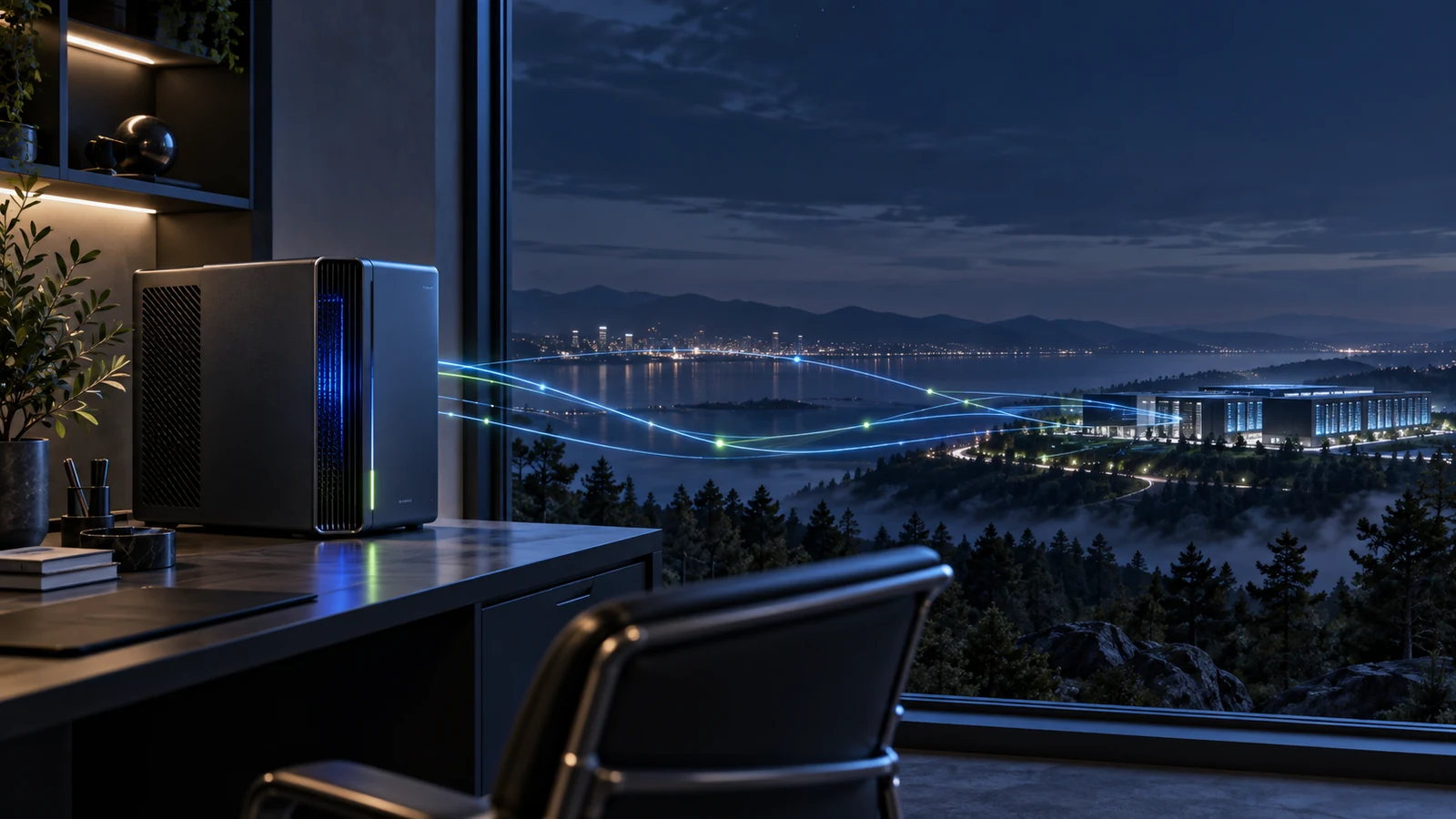
There is now a 122-billion-parameter AI model running on a workstation-class NVIDIA GPU beside my desk.
I asked it why the sky is blue. It answered in a few seconds.
That is not particularly impressive. A child can ask ChatGPT the same question from a phone. The interesting part is that this request never left my home.
No OpenAI. No Anthropic. No Google. No cloud API. No per-token charge. If my internet connection had disappeared halfway through, the model would have carried on answering.
The cloud won the first era of modern computing because it was convenient, scalable and economically irresistible. Why buy servers, maintain hardware and predict capacity when Amazon, Microsoft or Google will rent you exactly what you need?
The same logic shaped the first era of generative AI. The largest models required absurd quantities of hardware, electricity and engineering, so the only practical way to access them was through a website or API operated by somebody else.
That will remain true for the largest systems. Frontier-model training is not moving into your spare bedroom. Neither is the infrastructure required to serve hundreds of millions of people at once.
But our complete dependence on the cloud will diminish.
Not because the cloud failed. Because AI changes what dependence means.
Renting intelligence is different
When you store a photograph in the cloud, the provider is mostly holding bytes for you.
When you use a cloud AI system, the provider controls the intelligence itself.
It chooses which model you can use, how that model behaves, what it is allowed to discuss, how much context it accepts, what it costs, where your data is processed and when the service is withdrawn. The rise of so-called uncensored models is partly a reaction to that loss of control.
AI companies retire models and endpoints all the time. OpenAI and Anthropic both publish deprecation schedules. A model you build around today may simply stop accepting requests later, forcing you to migrate whether you want to or not.
Sometimes the replacement is better. Sometimes it is merely different.
Anyone who uses these systems seriously knows that models are not interchangeable commodities. They have different personalities, strengths, weaknesses, refusal patterns and ways of reasoning. A workflow built around one version can behave quite differently when the provider swaps it for another.
If your business, medical archive, family records or institutional memory depends on that system, this matters.
You are not only renting compute. You are renting continuity, and its terms can change without your consent.
Who does your agent work for?
When an AI system answers a question, it is still mostly a tool. When it begins booking travel, purchasing software, renewing insurance or selecting suppliers, it becomes something else: an economic actor operating on your behalf.
Asking an agent to “sort this out” conceals dozens of decisions. Which providers make the shortlist? Which criteria matter? Is the cheapest option shown first, the safest, the one you used previously, or the one with the most profitable commercial relationship with the platform?
Those choices may be difficult to see. A conventional search page at least gives you a list of results. An agent may compare the options, make the purchase and report only that the job is complete.
If the company operating that agent receives advertising revenue, commissions, referral fees or preferential access from particular providers, its incentives may not perfectly match yours. The danger is not necessarily one obviously corrupt recommendation. It is thousands of small decisions being quietly tilted in a direction you did not choose.
This is where owning your intelligence becomes more than a privacy argument. The important question is no longer only where the model runs. It is whose interests shape the decisions it makes.
Running a model locally does not automatically make it loyal. A local agent can still rely on sponsored search results, closed marketplaces or services whose incentives you cannot inspect. Ownership has to include control over the rules around the model, not just possession of the hardware.
A genuinely personal agent should let you define its priorities. It should disclose commercial relationships, compare meaningful alternatives, explain why it chose one provider over another and preserve an auditable record of consequential decisions. It should require approval above limits you set, rather than quietly expanding its own authority.
If the intelligence acting on your behalf is controlled by another company, that company may become an invisible intermediary between you and much of the economy. It will not merely answer your questions. It may shape what you buy, who you trust and which opportunities you ever see.
That is a much deeper form of dependence than renting server capacity.
Let me make this concrete
My own AI systems now hold an enormous amount of context.
They understand my companies, projects, documents, investments, operating procedures and writing. Separate agents help me manage corporate administration, research investments, build software, organise medical records and triage my inbox.
The model matters, obviously. But the accumulated context is becoming more valuable than the model itself.
That context includes years of decisions, corrections, documents, preferences and history. It is increasingly the operating memory behind how I work.
Sending every part of that memory to a third-party service is sometimes acceptable. Sometimes it is not.
A cloud model may remain the right choice for a difficult research question or a task requiring the strongest possible reasoning. But does every routine summary, document classification, diary update, private search or background process need to leave the building?
Obviously not.
Once a local model is good enough for the task, keeping the task local becomes the rational default.
This is no longer a fringe hobbyist movement. NVIDIA is selling desktop AI systems designed specifically to run and fine-tune large models locally. Microsoft now requires dedicated neural-processing hardware in its Copilot+ PCs. Apple decides whether an intelligence task can be completed on the device and only sends more demanding work to its private cloud infrastructure when necessary.
Different companies. Different implementations. Same direction.
Computers are becoming AI systems in the same way they became internet systems. The capability is moving into the device itself.
Most people are not going to install an enormous graphics card, configure model runtimes and spend their evenings reading benchmark results. They should not have to.
The likely consumer product is not “a GPU.” It is an AI appliance.
A quiet box in a home or office. It contains enough memory and compute to run useful models continuously. It connects to your files, devices and private data. It maintains your agents, memories and automations. When a task exceeds its capability, it securely escalates that task to a larger cloud model.
You will not need to understand quantisation, inference engines or memory bandwidth any more than you need to understand the packet-routing logic inside your Wi-Fi router.
You will simply know that part of your intelligence infrastructure belongs to you.
What owning the machine changes
Privacy is the obvious advantage.
If you paste a medical report, legal agreement, board paper or your child’s health history into a cloud model, you should assume the information has been disclosed to the provider under whatever contractual and technical protections apply.
That may be an acceptable trade-off. Often it is.
But data that never leaves your machine has a different security profile from data protected by a promise about what happens after it leaves.
Local processing does not magically make information safe. Your own system can still be hacked, misconfigured or physically stolen. Running private infrastructure means accepting responsibility for securing it.
The architectural advantage is still real. Keeping a processing event local removes the transmission and provider-retention risk for that event. It does not guarantee that another copy of the same information has not already been synchronised or disclosed elsewhere.
For healthcare, law, finance, family administration and commercially sensitive work, that matters.
Continuity may matter even more.
Cloud providers can change prices, policies and models. They can suffer outages, withdraw from a jurisdiction, or decide that your use case violates a policy written after you built the system.
A locally stored model continues running.
It may not remain the best model in the world. But it remains the same model. You can preserve the version, test it, adapt it and decide when to upgrade rather than discovering that an upgrade has been chosen for you.
This becomes especially important when AI agents move beyond answering questions and begin operating persistent workflows.
If an agent is maintaining your company’s memory, processing documents every night, monitoring systems or helping manage a long-running medical history, stability is part of the product.
Then there is cost.
Buying hardware is not automatically cheaper than using the cloud. GPUs are expensive. They consume electricity, generate heat and depreciate quickly. Hardware breaks. Drivers break. Software stacks break for reasons that are somehow always discovered at 2am.
For occasional use, renting compute is obviously more efficient.
But sustained AI usage changes the calculation. A company running agents continuously can accumulate enormous token bills. Every classification, summary, search, extraction and background task carries a marginal cost. The bill rises with usage, which means success can make the economics worse.
Owned hardware reverses that relationship. The upfront cost is high, but the marginal cost of another inference is mostly electricity. The hardware becomes more economical as utilisation rises.
The comparison is less like buying software and more like deciding whether to rent or own a factory. If you need occasional capacity, rent it. If the machinery operates all day and sits at the centre of how your business works, ownership begins to make sense.
Local AI is also faster and more resilient.
For a person typing a question, a second of network latency may not matter. For voice systems, robotics, security cameras, background agents and software making hundreds of small model calls, it does.
A useful personal agent should not need to send every observation across the internet before deciding what to do next.
Internet connections fail. APIs time out. Providers reach capacity. Accounts encounter billing problems. A local system can continue performing routine work while the cloud is unavailable.
That does not make it independent of the world. It makes it less fragile.
The future is hybrid
Framing this as local versus cloud misses the point.
The largest models and training jobs will remain in data centres. Routine work, sensitive memory and persistent agents will increasingly run locally, escalating to the cloud only when a task genuinely requires it.
That changes the relationship. The cloud becomes an accelerator rather than the sole owner of the intelligence layer.
People already understand data sovereignty: where information lives, which jurisdiction governs it and who can access it. Compute sovereignty is the next layer — retaining the practical ability to process your own information, operate your own agents and keep working when a provider changes its prices, policies or models.
Compute sovereignty is therefore not only about where computation happens. It is also about who controls the agent’s incentives, which commercial relationships can influence it, and whether you can inspect the choices it makes in your name.
At first, this will appeal to developers, wealthy enthusiasts, privacy-conscious users and businesses with enough sustained demand to justify the hardware. Then the machines will get smaller, quieter and easier to use. Operating systems will shift work between local chips and cloud models without anyone needing to understand how.
People will still use cloud AI every day. They will simply stop assuming that all intelligence must be rented from somebody else.
The cloud is where the largest intelligence will live.
Local hardware is where your intelligence becomes yours.
Dave Chapman is Chief Operating Officer and a director of Quantum Leap Acquisition Corp (NYSE: QLEP), a special purpose acquisition company focused on artificial intelligence, quantum computing and blockchain technology. This article reflects his personal views and is not investment advice.